The Pashinyan administration’s Crossroads of Peace (COP) initiative has generated much speculation. The main source of contention is whether the project is a facade for concessions vis-à-vis Azerbaijan or a long-shot gambit to promote regional economic integration — and peace. To foster greater understanding, this memo provides a concise overview of the COP — its background, features, and economic and geopolitical implications.
The COP officially aims to both link Azerbaijan with its Nakhichevan enclave and advance regional connectivity. But contrary to the Armenian government’s lofty claims, the project will deliver partial benefits. The COP is poised to advance Russo-Azeri interests in the South Caucasus, while perpetuating Armenia’s strategic isolation.
This memo concludes with a set of recommendations for expanding Armenia’s transportation connectivity — and strategic value, while maintaining its national interests.
Strategic Context
In late October 2023, at the Silk Road Forum in Tbilisi, Armenian Prime Minister Nikol Pashinyan unveiled the “Crossroads of Peace” (COP) project. This initiative is the culmination of Yerevan’s pursuit of peace, casting Armenia as a potential hub for regional transportation and communication networks. The project also seeks open borders with Azerbaijan and Turkey. (Baku and Ankara maintained a blockade around Armenia due to the decades-long dispute over Nagorno-Karabakh.)
The COP proposes links between Azerbaijan’s mainland and its Nakhichevan exclave, as well as a connection between Russia and Turkey. These routes are poised to traverse Armenian territory under its sovereign jurisdiction. The project, ostensibly beneficial for regional stakeholders, posits that the “South Caucasus requires enduring peace, characterized by open borders, and a tradition of resolving disputes diplomatically and through dialogue.”
This initiative is rooted in Armenia’s crushing defeat in the 2020 Nagorno-Karabakh conflict — and post-war security challenges. These events significantly altered Armenia’s strategic posture. Specifically, Yerevan abandoned its long-standing commitment to defending the Armenians of Nagorno-Karabakh and their right to self-determination, previously a cornerstone of Armenia’s national interests. This realignment was starkly illustrated in September 2023, when an Azerbaijani military assault, facilitated by Russia’s “peacekeeping” contingent, led to the rapid collapse of Nagorno-Karabakh and the ethnic cleansing of its indigenous Armenian population.
The COP, though a recent addition to the Pashinyan government’s foreign policy portfolio, draws from the decades-long negotiations agenda around the Nagorno-Karabakh conflict. In particular, the OSCE Minsk Group hosted negotiations between Yerevan and Baku concerning the re-opening of Soviet-era communications, while promoting lifting the blockade imposed by Turkey.
The reopening of transportation infrastructure consistently featured in settlement proposals around NagornoKarabakh — including the 2007-2009 Madrid Principles and the Moscow-facilitated Kazan agreements of 2011. (Moscow has long advocated for reestablishing regional logistics channels.)
This agenda gained renewed momentum following Armenia’s military defeat in 2020. The trilateral statement of November 9 — which concluded the 44-day war — codified the region’s geopolitical rearrangement, distinctly positioning Azerbaijan as the victor. Article 9 of this statement explicitly obligates Armenia to “ensure the security of transport routes connecting the western regions of the Republic of Azerbaijan and the Nakhichevan Autonomous Republic in order to organize the unhindered movement of citizens, vehicles and cargo in both directions.” Significantly, the document stipulates that the border service branch of the FSB, Russia’s domestic intelligence agency, will manage such transportation corridors.
In December 2021, a tripartite working group — composed of Armenia, Azerbaijan and Russia — was charged with overseeing the “re-opening agenda.” The group’s discussions confirmed that ArmeniaAzerbaijan infrastructure projects — whether requiring restoration or new construction — would strictly adhere to the trilateral deal, despite Azerbaijan’s repeated violations. This highlights Armenia’s one-sided commitment to upholding the trilateral statement — and providing Baku with logistical access to Syunik, despite Azerbaijan’s repeated violations. (The trilateral statement’s significance also extends beyond the infrastructural sector. The document sets the basis for post-war Armenia-Azerbaijan negotiations and cements the region’s geopolitical dynamics firmly in Baku’s favor.)
Project Overview: Featured Infrastructure
Although announced in October 2023, the COP initiative has been marked by a notable lack of detailed planning. The Armenian authorities have failed to clarify critical aspects of the project, including projected economic benefits and security arrangements. This opaqueness has fueled arguments that Prime Minister Pashinyan’s project might serve as a façade, an effort to re-contextualize concessions and arrangements among Russia, Azerbaijan, and Armenia for both domestic and Western audiences.
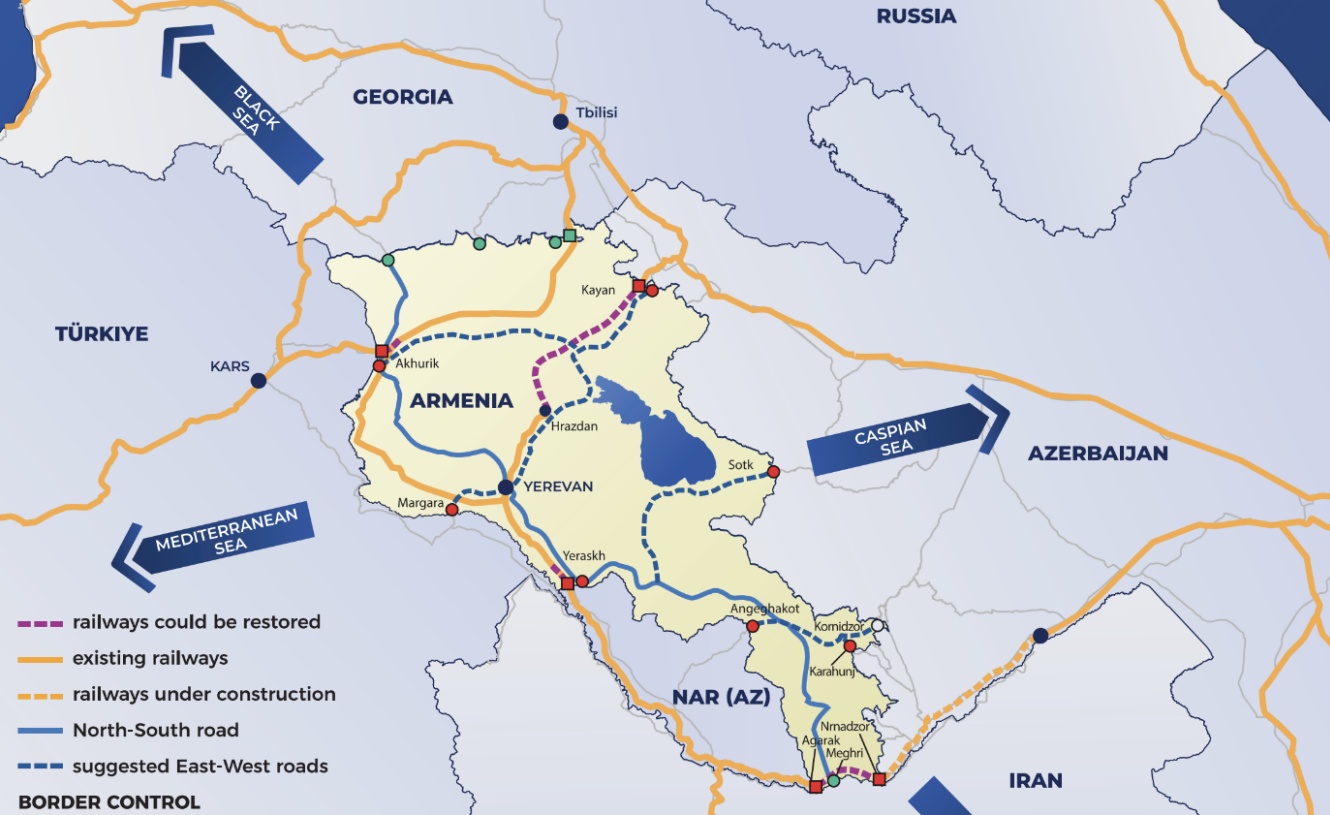
These arguments can be substantiated by a critical analysis of the infrastructural priorities outlined in the COP. The majority of the infrastructure projects — whether requiring restoration or new construction — predominantly facilitate connections between Azerbaijan and Turkey through Soviet-era logistics or link the Azerbaijan-controlled Eastern Zangezour (Eastern Syunik) with its Nakhichevan exclave. (These routes, mostly exploited during the Soviet era, were oriented towards serving the needs of Moscow’s centralized economy.)
The COP initiative also proposes connecting Lachin to Nakhichevan via a new KornidzorAngheghakot motorway and the restoration of a 42-km railway that runs along the border between Armenia and Iran (the former Soviet-Iranian border). While creating a direct link between Azerbaijan and its Nakhichevan exclave, these two infrastructure projects will effectively bisect Armenia’s strategic Syunik province. This territorial reconfiguration will likely limit Yerevan’s access to Syunik, while providing Baku significant economic and political sway across Armenia’s southern environs.
Regional Perspectives
Amid the region’s new geopolitical dynamics, following the collapse of Nagorno-Karabakh, Azerbaijan has shown limited interest in Pashinyan’s COP initiative, dismissing the project as “utopic.” Instead, Azerbaijan continues to focus on its envisioned Zangezur Corridor, which would include a railway — and highway — through the Armenian border town of Meghri. Azeri authorities routinely characterize this strip, a gateway to Nakhichevan, as “crucial for Baku in terms of national security and as an alternative route for the Middle Corridor.” The Zangezur Corridor is a critical plank in Azerbaijan’s geopolitical ambitions. (Azerbaijan aims to leverage the corridor to establish trade routes across Central Asia, Russia, Turkey and the European Union.) Due to its strategic utility, Azerbaijani President Ilham Aliyev routinely threatens to carve out the transportation corridor via force.
Azerbaijan’s rejection of the COP is grounded in Baku’s interpretation of Article 9 of the November 9 trilateral statement. Baku views the COP initiative as an attempt by Armenia to eschew its alleged commitments under the trilateral statement. For this reason, among others, Azerbaijan is pushing for the exclusion of Armenian customs controls along the route, preferring an extraterritorial corridor managed by Russian security services. Baku’s rigid stance reflects its long-term, zero-sum approach towards Armenia, an attitude that is shaping the region’s evolving infrastructural arrangements.
In contrast to Baku, Moscow responded to the COP initiative more positively, indicating that the project aligns with Russian interests. Alexey Overchuk, Russia’s Deputy Prime Minister of Eurasian Integration commented: “[Moscow] supports the construction of the Crossroads of Peace initiated by the Prime Minister of the Republic of Armenia, as Russia, like Armenia, is interested in diversifying transport routes.” A representative of Putin’s administration also revealed Russian investments around the renovation of Armenian transportation infrastructure. The source noted that the Moscow-led Eurasian Fund for Stabilization and Development has earmarked $533 million for Armenia’s transportation sector.
Significantly, Moscow perceives the COP as a chance to reduce Armenia’s dependence on Georgia for strategic communications with Russia. The COP provides an alternative to the Georgian route via Azerbaijan’s railway network. This network is poised to link Iran with Russia — and could facilitate even closer connections between Armenia and Russia. An anonymous source within Russia’s Foreign Ministry revealed that Pashinyan’s infrastructural plan was discussed with Russian counterparts before its official announcement. Both sides agreed that the “restoration of Soviet-era routes and fostering infrastructural interdependency under Moscow’s supervision in the Caucasus is crucial.” In this context, Alexey Overchuk publicly underscored Moscow’s waning interest in the Georgian Upper Lars pass, Armenia’s principal land artery to Russia, stating that the route “cannot provide a year-round transport link and hence seriously hinders the development of relations between Armenia and Russia.”
Moscow historically opposes international infrastructure initiatives that bypass Russia or undermine its politicoeconomic interests. Instead, the Kremlin promotes strategic links between North and South, or infrastructure that positions Russia and its uncontested spheres of influence as key transit routes. Moscow considers such projects vehicles to resist perceived Western efforts to isolate it. Moscow views the COP within this context, a route — beyond the reach of the West — that connects Russia and Turkey.
The Missing Link
According to the COP initiative, Armenia is poised to serve as a regional transportation and communications hub. Pashinyan frequently underscores the country’s “untapped” potential in its railway and motorway infrastructure. The Armenian government also routinely highlights the project’s significance for Armenia’s regional partners, including Georgia and Iran.
Despite these lofty claims, a thorough examination casts doubt on the supposed regional benefits of the COP. In contrast to detailed plans for linking Azerbaijan with Nakhichevan — and Turkey — via Armenian territory, Georgia-Armenia-Iran infrastructure remains neglected. While the COP references Armenia’s existing “NorthSouth Highway,” the initiative eschews new infrastructure that would foster greater connectivity among Iran, Armenia and Georgia. In fact, the COP, compounded by post-2020 geopolitical arrangements, have reduced the feasibility of Georgia-Armenia-Iran cooperation, particularly disrupting Armenia-Iran transportation capacity.
For instance, recent geopolitical concessions, rooted in Armenia’s 2020 military defeat, have compromised the competitiveness — and viability — of the yet-to-be-completed North-South Highway. In 2021, the unilateral withdrawal of Armenian forces from swathes of Syunik precipitated the partial Azeri takeover of the M2 highway, the main transportation route between Armenia and Iran. Azerbaijan has since impeded traffic along this interstate highway, forcing Armenia to establish an alternative route. The alternative route — which stretches from Meghri to Sisian via mountainous Kajaran and Tatev — remains deficient. The motorway’s load bearing capacity is grossly insufficient to accommodate regional trade flows. This capacity gap — and a host of other factors (i.e., speed, cost-effectiveness and security) — undermines the North-South Highway’s prospects as an inter-state, cross-regional transit corridor connecting the Gulf with the Black Sea.
The COP also neglects Armenia-Iran rail infrastructure, which could potentially connect with the Georgian railway system. An Armenia-Iran railroad project — of strategic importance to Armenia — has its origins in the Sargsyan administration. (The Armenian government adopted the project in 2014.) The initiative was a critical plank of the then government’s “Southern Railway of Armenia” scheme, which sought to connect Yerevan with Iran via Syunik. Despite its importance, the project — estimated at $3.2 billion in 2013 — was shelved, a likely victim of geopolitical calculations.
The Armenian authorities initially delegated the railway project to the Dubai-based investment firm Rasia FZE Group, which is likely affiliated with Russian state business interests. However, in 2015, Russian Railways, which operates the Armenian railway system, declared the project as “useless” and not aligned with the company’s interests. Besides often repeated refrains around the project’s financial infeasibility, geopolitical factors may also have contributed to the marginalization of the Armenia-Iran railway initiative. A direct link between the Persian Gulf and the Black Sea via Armenia — and Georgia — possibly unnerved Russia. Moscow likely viewed the Armenia-Iran railway — which circumvents Russian infrastructure — as a challenge to its geopolitical and economic interests.
Despite the project’s strategic value, the Armenia-Iran railway has been effectively dropped, overshadowed by Pashinyan’s COP initiative. The Armenian government’s COP project is more aligned with Russo-Azerbaijani interests, offering only nominal consideration to alternative routes. The neglect of the Armenia-Iran railway project is particularly significant. The now-shelved initiative could have improved Yerevan’s geopolitical position vis-à-vis Baku, while helping facilitate Armenia’s participation in cross-regional infrastructure initiatives.
Conclusion and Recommendations
The COP risks facilitating a Russian-Azeri-Turkish agenda at the expense of Armenia’s economic and geopolitical interests. The initiative — which expands outside influence over Armenian infrastructure — is poised to intensify Armenia’s economic, logistical and security dependence on both Russia and Azerbaijan. These developments will further compromise Yerevan’s autonomy and regional influence.
To avert such a scenario and advance its interests, Armenian policymakers — and society — should immediately:
- Prioritize the revival of the direct Georgia-Armenia-Iran railway project, avoiding Azeri territory;
- Expand Georgia-Armenia-Iran transportation infrastructure;
- Reestablish complete control over critical infrastructure, which may include the nationalization of the Armenian railway company or the establishment of an alternative state-owned firm; and
- Review Armenia’s one-sided commitment to the November 9 trilateral statement.