Leading this month
In March, regional developments were in full swing. Earlier in the month, Azerbaijan and Armenia released an awkward string of statements on the near completion of a normalization deal. The treaty — a veritable capitulation document — reportedly features a laundry list of long-coveted Azeri demands. (Many of these concessions are designed to subvert Armenia’s sovereignty and national viability.)
Despite attracting broad international support, the “peace” deal is poised to crystallize Armenia’s reduced status as a sovereign actor — while curtailing the West’s regional footprint. Proposed provisions include disbanding the EU border monitoring mission and OSCE Minsk Group, to Moscow’s delight. (Following the 2020 Nagorno-Karabakh War, Russia maneuvered to sideline the Minsk Group and its Western stakeholders. And Russia, Azerbaijan and Iran have vehemently opposed the EU mission — a limited, yet key source of on-the-ground Western influence in the South Caucasus.)
According to reports, the treaty also includes proposed clauses designed to suppress Armenian identify — under the guise of preventing “interethnic hostilities.” These provisions are poised to effectively prohibit domestic opposition to Azerbaijan’s designs vis-à-vis Armenia. Nagorno-Karabakh’s exiled Armenians could face additional restrictions on their political and civic engagement. Dissent against the “Western Azerbaijan” initiative, a pseudo-irredentist project that claims vast swaths of Armenia, is also likely to be targeted. (As part of its lofty ambitions, Azerbaijan has hinted at plans to resettle 300,000 Azeris across Armenian territory — with a particular focus on the Gegharkunik and Syunik provinces.)
No doubt, these provisions will invite abuse — wielded to curtail opposition activities and stifle civic freedoms. (In recent months, Armenian authorities have escalated attacks against political opponents and the public at large. And in neighboring Georgia, the ruling Georgian Dream is establishing a legal regime to decapitate the opposition.)
Against this backdrop of geopolitical tumult, Armenia is signaling warming ties with Russia and backpedaling its hallow pro-Western pivot. (Like in neighboring Georgia, Armenia has engaged in a campaign of performative engagement with the West — in part to mislead international stakeholders and minimize the perception of Russia’s role across regional affairs, including the upcoming normalization accords.) But despite a stream of specious commentary, Russian influence remains firm in the South Caucasus and Central Asia.
In fact, Moscow — via large-scale disinformation and sustained political operations — has managed to covertly reshape the region’s geopolitical order in its favor. (Georgia and Armenia are secured, and Azerbaijan is a trusted regional proxy.) Amid these favorable conditions, the Kremlin is pursuing regional projects, such as the Eurasian Union, Union State and 3+3 format, as part of a gambit to consolidate recent gains.
What we are watching
Hybrid operations. In January, Ukrainian news outlet UA.NEWS published an expose on the strategic failure around the Chonhar bridge — and Azerbaijan’s potential role in facilitating Russia’s lightning advance. (Chonhar links Ukraine’s Kherson region to Crimea.) In recent years, Kyiv’s failure to secure the critical roadway — which provided Russian forces easy access to Ukraine’s southern hinterlands — has been the subject of intense speculation.
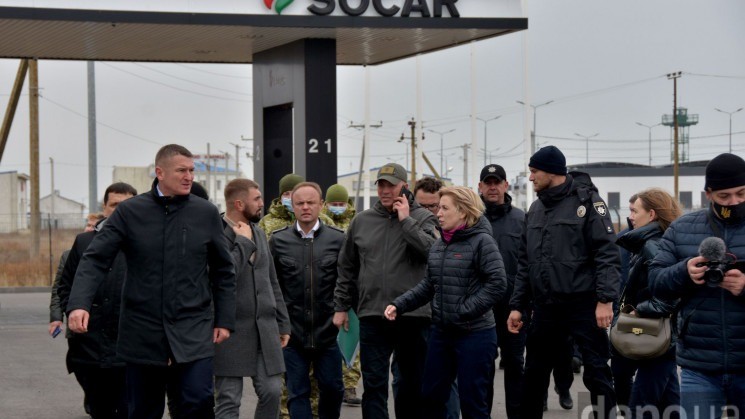
Azerbaijan’s role has attracted particular scrutiny. In 2020, Azerbaijan’s state-owned energy giant SOCAR secured a contract to modernize the Chonhar crossing point. (Plans included a services hub and petrol station.) But observers suggest Baku gained access to — and demined — the strategic site as part of an arrangement with Moscow. Despite the serious allegations, Kyiv has remained silent. (According to the expose, Azerbaijan maintains significant influence across Ukrainian political circles, sustained by a web of strategic corruption.)
Azerbaijan has a long track record of grey zone activities around Ukraine. Last year, ISA exposed how Azerbaijan diverted weapons earmarked for Ukraine via operations in Bulgaria and Slovakia. And in recent years, Azeri firms, acting on behalf of Russia, have targeted Ukrainian critical infrastructure. In October, Cemin Ukraine, a subsidiary of Azerbaijani conglomerate NEQSOL Holding, acquired a Ukrainian titanium producer, as part of a $96 million privatization deal. (According to well-placed sources, NEQSOL Holding served as a Russian proxy.)
Abkhazia elections. Amid a protracted geopolitical crisis, Abkhazia hosted run-off presidential elections on March 1. The Kremlin’s favored candidate Badra Gunba declared victory, securing 55 percent of the vote. (To bolster Gunba’s prospects, Russia announced the resumption of financial assistance — suspended since September — and increased electricity supplies amid a crippling power deficit.)
This electoral cycle was marked by a pronounced rise in voter manipulation and intimidation. And the statelet’s sizable Armenian community was the subject of a sustained disinformation effort.
Since the summer, Abkhazia has been mired in cascading crises triggered by the deterioration of Moscow-Sukhumi ties. This fraying of relations was spurred by widescale Abkhaz opposition to a Kremlin-favored legislative package — which would lift a moratorium on foreign property ownership. (Many Abkhaz — long wary of ceding sovereignty — perceive the investment deal as an existential threat and a ploy to expand Russian clout.)
Municipal governance. On March 30, high-stakes snap elections were held in Armenia’s second city Gyumri — and the neighboring community of Parakar. A series of opposition parties secured a majority of the vote. (In Gyumri, the ruling Civil Contract party led with 36 percent.) Coalition talks to elect a mayor are currently ongoing. According to preliminary reports, two opposition blocs — Mother Armenia and the My Strong Community — are backing Vardan Ghukasyan, a controversial former mayor of Gyumri. And despite a long-standing rivalry, Martun Grigoryan’s opposition bloc is also poised to back Ghukasyan.
In recent years, the Pashinyan administration has subverted municipal governance as part of a campaign to consolidate domestic power — and stifle political competition. (In several countries — Turkey and Algeria — upstart parties have leveraged municipal politics as springboards to national government.) In 2021, the Armenian authorities slapped corruption charges on Vanadzor’s newly reelected mayor. And in 2023, Armenian authorities moved to disrupt opposition-run municipalities in Gyumri and Alaverdi.
Deals and visits ✈️
- Azerbaijan, Kazakhstan and Uzbekistan ink green energy accord
- Armenian investment fund acquires Goldman Sachs’ Russia unit
- SOCAR signs gas exploration agreement with Israel
- Georgian Prime Minister visits Central Asia, eyes economic cooperation
- Turkish, Italian defense giants launch joint drone venture
What we are reading
- Azerbaijan to join Abraham Accords? (i24News)
- Baku endorses Georgia’s shift away from the West (DFR Lab)
- Can Gazprom be revived? (Financial Times)
- Hungary extends assistance to the Georgian Dream (VSquare)
- Azerbaijan escalates campaign against minority activism (Caucasian Knot)