Since the 2020 Nagorno-Karabakh conflict, Russia has rapidly expanded its military footprint across Armenia, developing a constellation of security outposts across the Syunik province. These security sites are concentrated across two strategic zones: the Iran-Armenia border and Armenia’s borderlands with Azerbaijan and Nagorno-Karabakh.
Amid growing Moscow-Baku geopolitical cooperation and Russia’s interest in carving out the so-called Zangezur Corridor, the continued presence of Russian forces across swathes of Syunik poses a growing challenge to both Armenia’s sovereignty and national security capacity. Azerbaijan’s recent territorial gains, including its occupation of sovereign Armenian territory in September 2022, has left Armenia’s southernmost provinces of Syunik and Vayots Dzor outflanked and dangerously vulnerable. The next phase of Azerbaijan’s military campaign likely includes an assault on both provinces. To adequately prepare for the region’s defense, mapping the activities and risks of Russian military deployments is necessary.
This memo concludes with recommendations for an organized, prioritized, and resourced effort to help Armenia restore sovereignty over Syunik.
Security Outpost Networks: An Expanded Lever of Strategic Influence
Following the 2020 conflict, Moscow, which helped choreograph Baku’s victory, capitalized on Armenia’s security crisis and expanded its already-substantial military presence. Russia’s military buildup was largely concentrated on Syunik. Russia’s newfound military outposts are composed of various Russian security services, including border guards, which are managed by Russia’s Federal Security Service, the FSB.
The “Treaty on the Status and Conditions of the Activity of the Border Guard Troops of the Russian Federation in the Republic of Armenia,” signed in September 1992, and the “Protocol N5 on Prolongation of the Presence of the Russian 102nd Military Base in the Republic of Armenia,” ratified in 2011, established the legal basis for Russia’s military presence in Armenia. The 2011 protocol lifted restrictions on Russia’s security presence, authorizing the stationing of Russian forces across the country.
In May 2021 and September 2022, the Armenian government allotted land for Russia’s expanding military infrastructure. These land allocations, which included territories in Kapan, Meghri and Tegh, served to accommodate additional troop deployments and the establishment of outposts for Russian servicemen.
Between March 2021 and June 2023, the FSB renovated, expanded, and established infrastructure for border guards and other Russian military services permanently stationed across Syunik, particularly in areas adjacent to the Armenia-Iran border. This includes territory along the Soviet-era railway route connecting the Azerbaijan SSR to Nakhichevan. (This is Azerbaijan’s designated route for the Zangezur Corridor.) Amid this buildup of military infrastructure, Russia has deployed additional security personnel to the region. By August 2023, approximately 2,000 Russian security were stationed in Syunik.
In addition to the deployments in the Armenia-Iran border checkpoints in Agarak, Russian servicemen control the entire Armenia-Iran borderline. Russian forces also occupy 3 kilometers along the Armenian-Azerbaijan borderline starting from the point where the Armenian, Azerbaijani and Iranian borders connect on the Arax River.
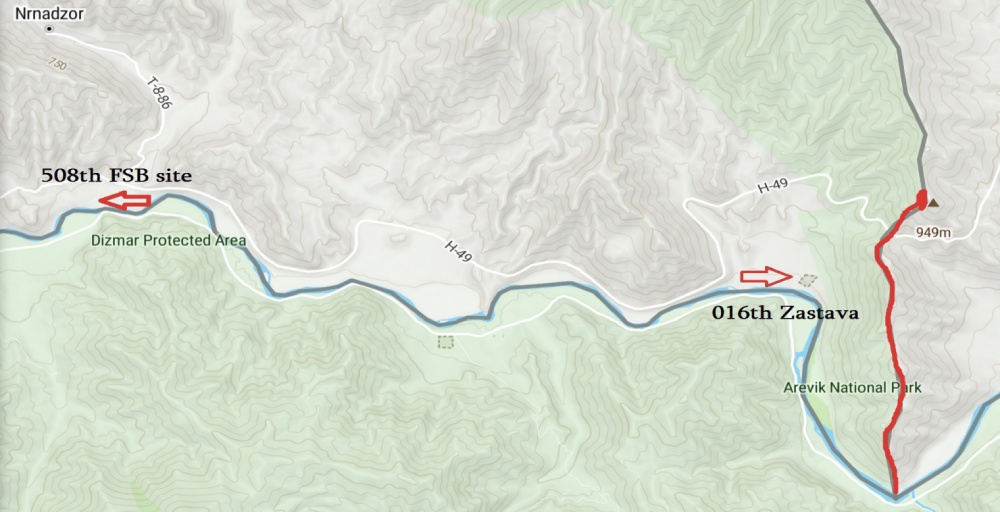
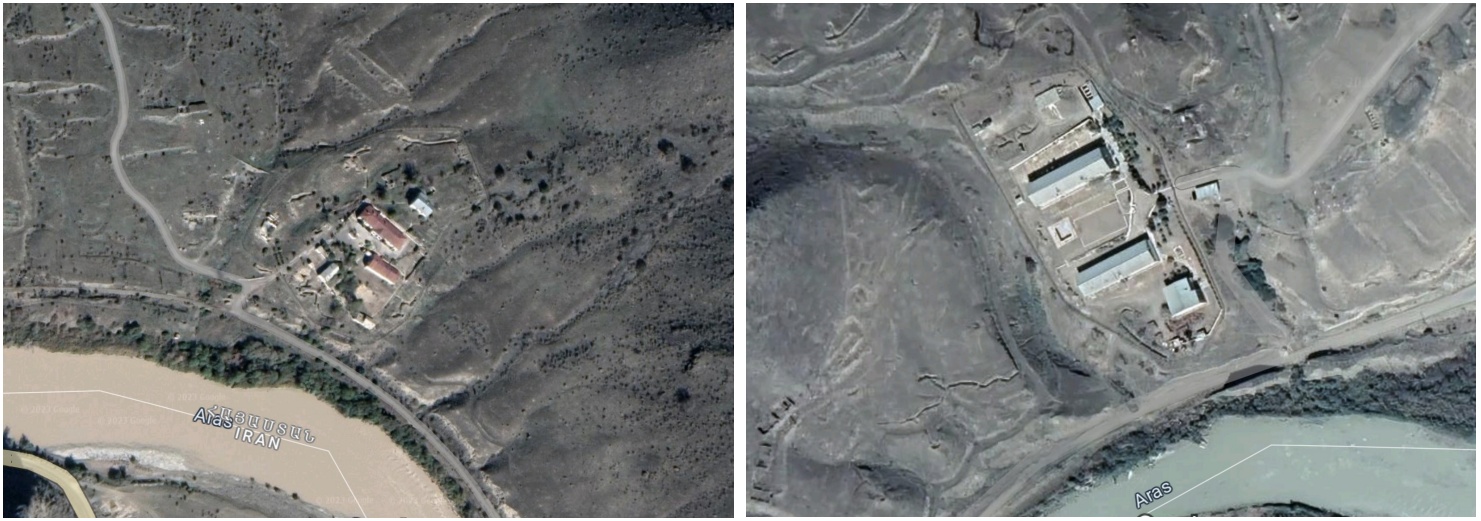
In the southeast of Syunik, across the Arax river (Armenia-Iran border) and the former Soviet railway line, Russia maintains the 016 military site (38.889954, 46.524394). Russia also operates the 508th site of the Russian FSB (38.898426, 46.442672) along the border below the village Nrnadzor.
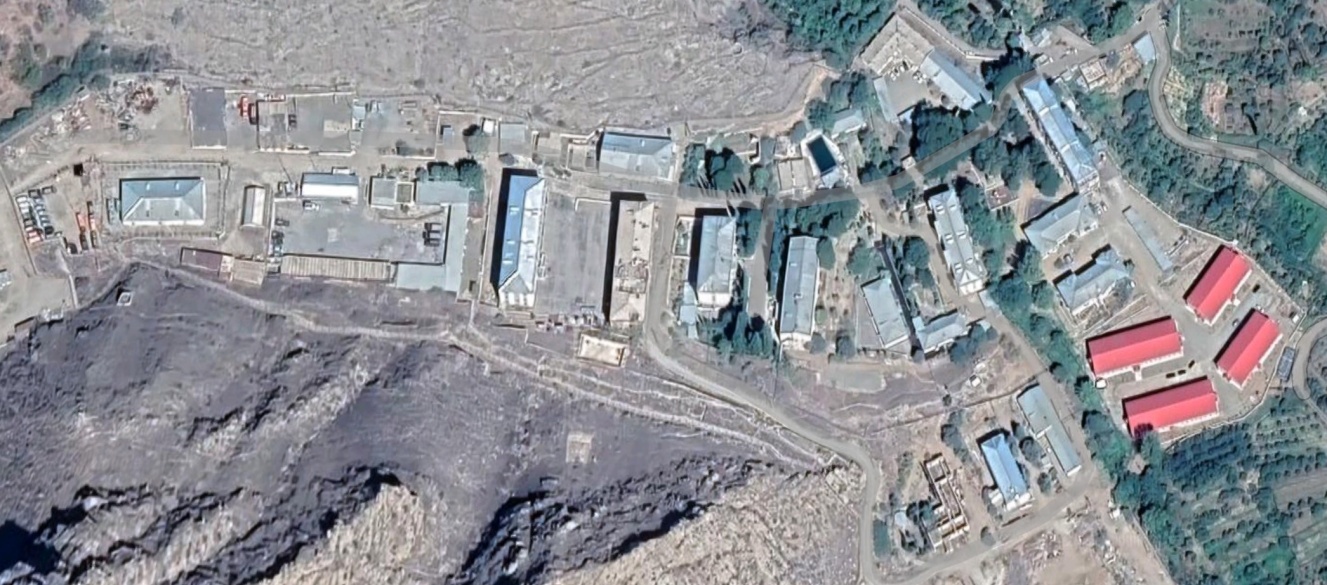
Other Russian military facilities include the 21th FSB border guard site (38.917472, 46.338068) located below the village of Alvank and the main FSB base (38.891307, 46.254642) in Meghri. The FSB headquarters predates the 2020 conflict but has significantly expanded since 2021. In Agarak, near the customs facilities, Russia maintains another FSB border guard site, the 411st outpost (38.854985, 46.204548), which underwent renovation in 2022.
At the western end of the Armenia-Azerbaijan-Iran triangle near Nakhichevan, the Russians operate another (unknown number) military outpost (38.843502, 46.156743). This military site is currently under construction, or expansion, and will establish Russian control over the 3 kilometer borderline between Armenia and Nakhichevan.
A Creeping De Facto Occupation
The consolidation of the FSB’s outpost network — and the occupation of vast swathes of territory — has raised concerns of Armenia’s loss of de facto control of Syunik to Russia, Yerevan’s erstwhile security partner turned adversary.
Since 2020, Russian security outposts have mushroomed across Syunik, extending far beyond Armenia’s borders. At present, Russian security services occupy 23 sites in Syunik. Moscow has established military outposts in the strategic villages of Shikahogh and Tegh, located at the mouth of the Lachin Corridor. Russian forces likewise maintain a large presence in Goris and surrounding villages — Davit Bek, Nerkin Hand and Khndzoresk. Russia also operates sizable outposts at Meghri and Sisian airports, both critical logistics hubs for the defense of Syunik. The forthcoming Russian diplomatic mission in Kapan is also poised to host 43-45 personnel.
Russia’s near total takeover of Syunik’s strategic sites and infrastructure has gradually eroded Armenian control over the region. Russian security forces operate with complete autonomy, without the oversight of the Armenian government or military. Territories occupied by Russian military outposts are likewise de facto offlimits to Armenian security agencies. Russian forces routinely deny the Armenian military and European Union monitoring mission access to borderlands, a violation of Armenian sovereignty.
Since 2020, Russian breaches of Armenian sovereignty in Syunik have escalated. Towards the end of 2021, the Russian FSB service managed to install checkpoints along the Meghri-Kapan and Kapan-Goris motorways, allegedly without the consent of the Armenian government. Two checkpoints were later removed, with Moscow claiming the FSB’s actions were previously coordinated with both Armenia and Azerbaijan. At present, several Russian-manned checkpoints remain in operation.
Amid Moscow’s pivot to Azerbaijan, Russia’s de-facto occupation of Syunik has evolved into a serious national security challenge. Constrained mobility — restricted access to strategic sites and infrastructure — will severely hamper Armenian defense preparations. Failure to reverse these skewed on-the-ground power dynamics could result in Syunik’s partial loss to a Russo-Azeri campaign.
Russian Troops: A National Security Threat
As the Moscow-Baku axis forges ahead with its geopolitical agenda, Russia’s lingering military presence in Syunik is a major threat to Armenia’s national security. The primary concern is that Russia may mobilize its local security apparatus to sabotage Armenian defenses, while facilitating Azerbaijan’s seizure of the region. (The Russian “peacekeeping” mission similarly abetted Azerbaijan’s creeping takeover of Nagorno-Karabakh in 2021-2023.)
Syunik features prominently in the geopolitical ambitions of Russia and Azerbaijan. Both countries aim to carve out the Zangezur Corridor – an envisioned extraterritorial, Moscow-managed corridor connecting Russia to Turkey via Syunik. Russia is poised to leverage the transportation route to weather the economic fallout of the Ukraine conflict and circumvent tightening international sanctions regimes.
Given Moscow’s recent conduct, Russian troops are potentially a potent tool in Azerbaijan’s arsenal. Russia’s outposts are strategically stationed along the Iran-Armenia border, Azerbaijan’s proposed route for the Zangezur Corridor. Since the 2020 war, Baku has dashed to restore Soviet era train lines connecting Azerbaijan proper with Nakhichevan, anticipating the restoration of the route via Syunik. With de facto control of the route — and the absence of Armenian troops — Russia could smoothly facilitate the transfer of the strategic route under the cover of an Azeri assault.
With an impending assault on Syunik, Armenia must acknowledge its precarious control over the strategic region — a crisis of its own making — and develop plans to restore its sovereignty vis-a-vis Russia.
Conclusion and Recommendations
As Azerbaijan seeks to consolidate its post-war geopolitical gains, a decisive, Russia-sanctioned assault on Syunik is highly likely. Preparing for the successful defense of Armenia’s southern heartland requires the total restoration of Armenian sovereignty. To this end, Yerevan should focus on eroding Russia’s security presence, while expanding Armenia’s own influence and capabilities. Failure to restore Armenian sovereignty will render a defense of Syunik and Vayots Dzor nearly unfeasible and precipitate the occupation of the strategic province.
To avert such a scenario, Armenian policymakers — and society — should immediately:
- Take bold action to erode the autonomy of Russian forces;
- Pursue withdrawal of Russian forces from all strategic sites, including the entire length of the Armenia-Iran border;
- Undermine the capacity of Russian forces to conduct hostile activities;
- Reestablish complete control over critical infrastructure, including logistics hubs;
- Reorganize Armenia’s force posture across Syunik and expand its military capabilities;
- Prioritize intelligence-gathering and analysis on Russia’s local security capabilities;
- Prepare a comprehensive plan to achieve the full withdrawal of Russian military forces from Syunik and Vayots Dzor, while mitigating the risk of a Russian backlash.